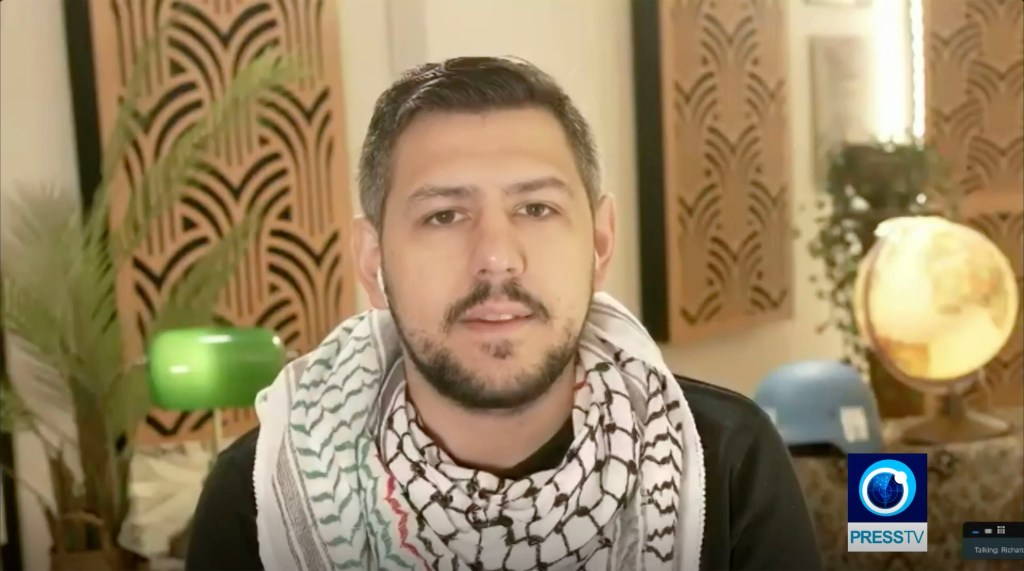
Bombshell… breaking news – UK journalist Richard Medhurst was arrested at Heathrow under Section 12 of the UK Terrorism Act. (That was nine days ago, although you’d be forgiven for not knowing anything about it, since there has been an almost complete silence in the British media.)
So what’s the story, here? Or, rather, where is the story? The Guardian, in common with every UK newspaper or TV channel, still has zero coverage following what’s almost certainly the first arrest of a UK journalist under these circumstances, for something he’s published – about Israel, Palestine… Iran? There clearly is a story here – and an important one. It concerns free speech and the freedom of the press. You would have thought The Guardian – or the BBC, The Times, The Independent, even The Sun or The Telegraph – would have something to say, if only to confirm that this man is involved in terrorism (assuming that an arrest did take place and the whole thing wasn’t just made-up ‘fake news’ dreamt up by Russia or China). So, why the silence?
It’s baffling that trusted brands of the liberal left, such as The Guardian, appear so reluctant to show their ‘progressive’ colours when it comes to certain topics of seemingly earth-shattering significance. It’s almost as if there’s some invisible grip around the UK media’s throat (or balls, and that includes the BBC’s), stifling debate or scrutiny when it comes to selected policies, strategies or undertakings of the establishment and its sponsors. (Or is that going too far down a conspiracy rabbit hole?)
This follows another non-story, just two days previously, about the bombshell resignation of senior UK diplomat Mark Smith – completely absent from mainstream media for a full 48 hours after the news broke on alternative channels. Even when the story finally appeared, its significance was downplayed, along with the issues that drove Smith to resign – namely the legality or otherwise of our complicity in the Gaza conflict, and Labour’s about-turn on its pre-election demands for release of the legal advice on the matter kept secret by the Tories.
Whatever their political leaning or bias, Journalists and their publications have a duty to remain honest and objective, and to keep their readers informed, without concealing truths or promoting untruths under pressure or influence, financial or otherwise.
This is from the newspaper’s ‘About Us’ page… “Guardian Media Group is a global news organisation that delivers fearless, investigative journalism – giving a voice to the powerless and holding power to account. Our independent ownership structure means we are entirely free from political and commercial influence. Only our values determine the stories we choose to cover – relentlessly and courageously.“
Okay, so is there a story to report here? And who is Richard Medhurst? According to Homeland Security News Wire, Medhurst is a presenter on Press TV – an Iranian state-owned news network that broadcasts in English and French. That channel was set up in 2007, as part of Iran’s IRIB network, to cover middle-eastern affairs and counter the perceived narratives of, principally, the BBC, CNN and Al Jazeera in the region.
In April 2023, the Anti-Defamation League published that “Press TV, a broadcasting brand founded by Iran’s state-controlled media corporation, is a platform used to promote the Iranian state’s hateful views of Jewish people, Holocaust denial, and LGBTQ+ and women’s rights to the rest of the world.” To back that up, it claimed that “Press TV uses social media to promote ‘Palestine Declassified’, a video series which focuses its hatred towards British Jews, but spreads hateful narratives and lies about Jewish people as a whole.“
Frequent hosts of ‘Palestine Declassified’ include prominent UK supporters of Palestine, including Asa Winstanley, David Miller, Chris Williamson and Richard Medhurst, which ADL calls “‘useful idiots’ who have previously faced allegations of antisemitism“. (What those allegations are is not clear.)
While these journalists and the themes of the videos are clearly anti-Zionist and pro-Palestinian, there’s little evidence of antisemitism unless you subscribe to the ADL’s definition that equates antisemitism and criticism of the government of Israel. One might argue that it drifts into conspiracy theories, such as the commonly-circulating claims of Tommy Robinson’s links with Israeli right-wing groups, and the regimes involvement in the recent UK riots.
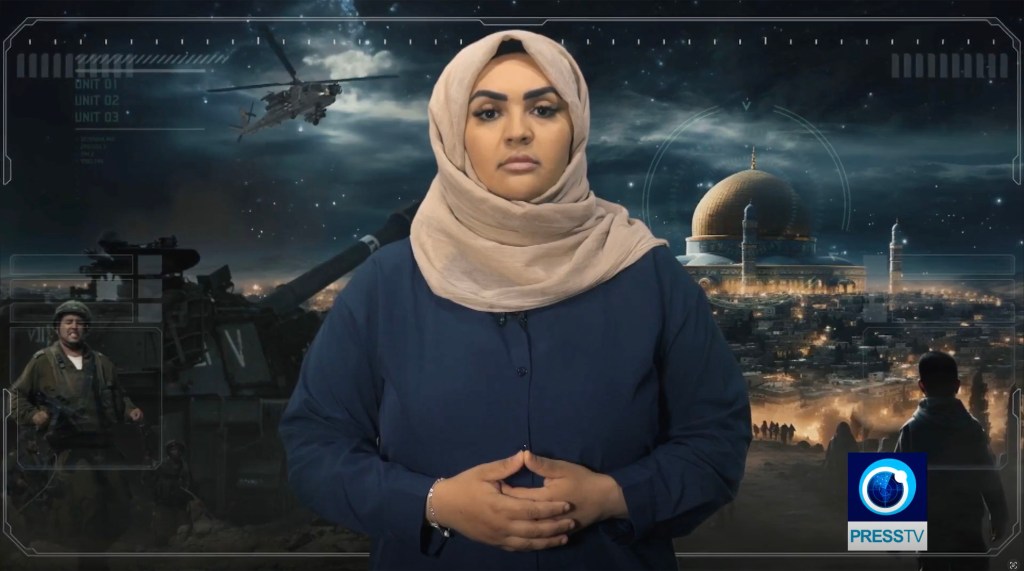
The language isn’t what you’d expect from, say, BBC coverage when it comes to, for example, the assassination of Hamas negotiator Ismail Haniyeh in the Iranian capital, Tehran, calling it “diabolical”, while AI imagery and animations reminiscent of Soviet-era state TV, current North Korean news broadcasts, or something from the TV series Homeland form a backdrop to the main presenters. Foreign correspondents and commentators, such as Medhurst, generally make their contributions via webcam, from less dramatic locations such as their bedrooms or home offices. Aside from the imagery and occasional strong word describing Israel’s latest actions, the rhetoric is surprisingly restrained, with criticism focused on the government of Israel and not against Jews.
In a recent video, released on 3 August, Richard Medhurst reports on the escalation of hostilities between Israel and Hezbollah. It’s clear to see where his sympathies lie between the two protagonists, but he consistently treads the standard journalistic line, avoiding overt support for either, and going nowhere near antisemitism or incitement to hate. He is unequivocal in his views on Palestinians’ right to freedom, their right to resist occupation and their right to self-determination. But these are all views expressed by the United Nations and by the vast majority of nations across the world. So, exactly what evidence is there against Medhurst – what has he said or written that is such a threat to our national security or social cohesion?
Born in Damascus to a Syrian mother and English father, both Medhurst’s parents served in UN Peacekeeping and Observer missions and were among the peacekeepers awarded the Nobel Peace Prize in 1988. The journalist’s website lists regular contributions to Al Jazeera, The Times, and LBC, in addition to Press TV.
Whatever the legitimacy of Medhurst’s arrest, the story warrants examination on the basis that it involves UK journalists and confronts the principles of freedom of the press to comment and criticise without threat or coercion. Terrorism laws should not be seen as a cover for silencing dissent without accountability or explanation. And, where the state acts without transparency, it’s the job of the press to uncover the truth – facts and context – ask the difficult questions, and hold authority to account. The big story here is, not Medhurst, but why the silence from the media?
Outside of alternative news and social media, you need to look far to find even a mention. The Palestine Chronicle reported that, as Medhurst arrived at Heathrow, he was met by six police officers, was arrested, questioned and detained for 24 hours. He was handcuffed and searched, at the airport and again in custody. “My journalistic equipment and devices were seized, including phones, SIM cards, wireless microphones, microphones, headphones, even my shoelaces. They later took my DNA as well, my fingerprints, palm prints, and photographed me.” He said “I believe I’m the first journalist to be arrested under this provision of the Terrorism Act. I feel that this is a political persecution and hampers my ability to work as a journalist.“
The Times of Israel covered the story on 20 August, describing Medhurst as someone who “spread conspiracy theories regarding Hamas’s October 7 terror onslaught, including by insisting that there were no acts of sexual violence committed by Hamas terrorists, and asserting that the victims of the massacre were killed by the IDF, not by Hamas.“
Chris Hedges, writing for Jewish Voice for Labour, claimed that “the arrest of the reporter Richard Medhurst, who has been one of the most ardent critics of the genocide in Gaza and Israeli apartheid state, at Heathrow airport is part of the steady march towards the criminalization of journalism, something all of us, including Medhurst, understood lay at the heart of the long persecution of Julian Assange.“
There are sides taken here, clearly. An Iranian state-funded news channel will not be taking a pro-Israel stand on the Gaza conflict, and those contributing to its news output – whether Iranian or UK journalists – are unlikely to be sympathetic either to Israel’s narrative or to its military and political backers, namely the US and (to a lesser extent) the UK. Empathising with the plight of Palestinians, whether in Gaza, or elsewhere in the occupied territories, does not, by necessity, imply support for proscribed groups such as Hamas or the atrocities carried out on October 7. Calling out Israel for war crimes does not constitute hatred against Jews.
But, just as peace protesters in London should not be censured on the basis of conflated antisemitism or made-up ‘hate’, journalists should have the freedom to investigate, report and comment on events as they see them, injustices as they see them, and uncomfortable truths as they see them – regardless of government policies and commitments to allies or sponsors. When the UK press shies away from covering issues or events that are out of step with official narratives – uncomfortable or embarrassing to the state – there’s a far bigger story that needs to be investigated. But who’s going to do it? The Guardian?
 EarthToll - lost for words …